 how-to
How to Choose a Statement Necklace for a High Neckline
Last Updated: November 7, 2026
Quick Summary
Choose a statement necklace long enough to clear the collar, scaled to the neckline's width, and balanced against the dress's fabric and detail. Long chains and pendants that drop below the collar line usually read best on closed necklines. Test the piece on the full outfit before the event.
- Identify your neckline type first, since each one handles a necklace differently.
- Pick a necklace that falls a few inches below the base of the neck.
- Match scale, shape and placement: a single focal element suits narrow necklines.
- Use smooth fabrics for bold pieces and clean-line necklaces for textured ones.
- Sit, turn and reach in the full outfit to check the necklace stays in place.
Table of Contents
- Why High Necklines Change the Rules for Statement Necklaces
- Step 1: Identify Your Neckline Type
- Step 2: Choose a Necklace Length That Clears the Collar
- Step 3: Match Necklace Shape and Scale to the Neckline
- Step 4: Read the Fabric, Pattern, and Embellishment
- What Necklace to Wear with a High Round Neckline
- Step 5: Test Fit, Movement, and Balance Before the Event
- Booking Your Statement Piece for Your Next Event
- Frequently Asked Questions
Why High Necklines Change the Rules for Statement Necklaces
A high neckline changes how a statement necklace works.
A statement necklace is a bold, eye-catching piece meant to be the focal point of an outfit.
The common mistake is choosing a necklace based only on how it looks on a hanger.
Quick answer: pick a necklace long enough to clear the collar, scaled to the neckline's width, and balanced against the dress's fabric and detail.
Step 1: Identify Your Neckline Type
Start by naming your neckline. The shape of the neckline decides where a necklace can sit and how much room it has.
Common high-neckline types include:
- High round neck (crew neck): A closed, circular neckline that sits at the base of the throat.
- Mock neck: A short, folded-over collar that stands near the throat without fully closing.
- Turtleneck: A tall, fitted collar that covers the neck.
Each type handles a necklace differently. A high round neck leaves little visible skin, so a necklace usually sits on top of the fabric or just above the collar.
The article breaks high necklines into a few common types, and each one handles a necklace differently.
| Neckline type | Description | How a necklace sits |
|---|---|---|
| High round neck (crew neck) | Closed, circular neckline at the base of the throat | Sits on top of fabric or just above the collar |
| Mock neck | Short, folded-over collar near the throat | Stands near the throat without fully closing |
| Turtleneck | Tall, fitted collar covering the neck | Covers the neck; needs a long drop |
| High collar or Peter Pan collar | Structured collar framing the face and neck | Frames the face and neck |
| Boat neck or bateau | Wide, horizontal neckline across the collarbones | Rests on the collarbones with more freedom |
Step 2: Choose a Necklace Length That Clears the Collar
Length is the most important decision on a high neckline. Too short and the necklace gets lost under the collar or presses against the fabric; too long and it can tangle or hang awkwardly.
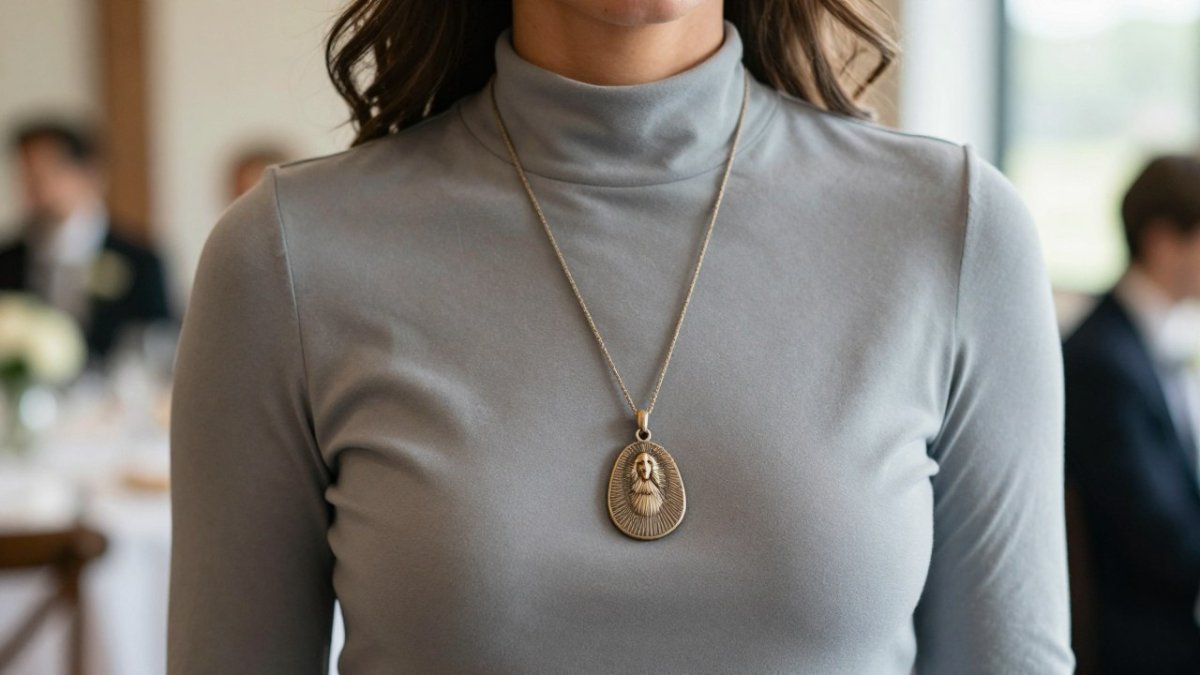
For closed or high necklines, look for necklaces that fall below the collar line. Most people find that a chain or pendant resting a few inches below the base of the neck reads best.
Long chains and pendants for closed collars
Long chains and pendants are often the most reliable choice for closed collars, letting the pendant drop past the collar and sit on the chest where it can be seen clearly, especially a single, well-scaled pendant with real visual weight.
Here is what to check when you try a long necklace on a closed collar:
- The pendant sits below the top of the collar, not tucked under it.
- The chain does not pull the collar out of shape.
- The necklace stays put when you move your head.
A common mistake is buying a long necklace that looks right in the box but sits too high once you put on a dress. Always test it on the outfit you plan to wear.
Step 3: Match Necklace Shape and Scale to the Neckline
This is where most high-neckline advice stays vague. "Match the shape to the neckline" sounds helpful until you are standing in front of a mirror with three statement necklaces and no way to choose. Use a three-part framework instead: scale, shape, and placement.
Scale: match visual weight, not inches
Scale is about how much visual weight the necklace carries, not its physical width. A chunky collar of beads and a thin geometric bar can occupy the same horizontal space but read very differently.
A practical way to judge scale is to compare the necklace's visual mass to the neckline's visual mass:
- Closed, narrow necklines (mock neck, high round neck): The fabric already fills the space from throat to collarbone. Choose a piece with a single focal element rather than a wide band of stones or a multi-row collar. A pendant with one strong stone, a sculptural bar, or a compact cluster keeps the neckline from looking packed.
- Wide necklines (boat neck, bateau): The horizontal line is the dominant feature. A piece that is wider than it is tall, a curved collar, a fan, a graduated bib, echoes that line and fills the open collarbone area without crowding it.
- Tall collars (turtleneck, high collar): The vertical height of the collar is the visual mass. A necklace with vertical movement, a drop pendant, a lariat, a slim bar, continues that line instead of cutting across it.
A common pattern among stylists is the "one-third rule": the necklace's focal area should read as roughly one-third of the visible neckline width, not half or more.
Shape: echo, contrast, or bridge
There are only three relationships a necklace can have with a neckline, and each produces a different effect:
- Echo: The necklace repeats the neckline's geometry. A round bib on a crew neck, a curved collar on a boat neck, a rectangular pendant on a square high collar. Echoing reads as calm and intentional and is the safest choice for formal events.
- Contrast: The necklace deliberately breaks the neckline's line. An angular geometric piece on a soft round neck, or a long vertical drop on a wide horizontal boat neck. Contrast draws the eye and works when the outfit is plain and you want the jewelry to be the focal point.
- Bridge: The necklace connects the collar to the chest by spanning the transition. A long chain with a pendant that sits below the collar does this. Bridging is the most reliable approach for closed collars because it gives the eye a path from the high neckline down to the jewelry.
Watch out: contrast only works when the outfit is quiet. An angular piece against a round neck is striking on a solid sheath; against a patterned or embellished bodice it reads as clutter.
Placement: decide where the focal point lands
Placement is the decision most people skip, and it determines whether a statement necklace looks deliberate or accidental. Before you buy, decide where you want the eye to stop:
- At the collar line: The necklace sits at or just above the top of the collar. This works only with a compact piece and a collar that has some give, because the necklace will press against the fabric.
- Just below the collar: The focal point rests an inch or two below the collar's base, on the upper chest. This is the most versatile placement for high necklines and the one most stylists default to for mock necks and crew necks.
- Mid-chest: A long pendant or lariat drops well below the collar. This placement suits turtlenecks and high collars, where a shorter piece would disappear into the fabric.
Test placement by putting on the outfit and marking, with a finger, where you want the focal point to sit. Then hold the necklace up and see whether its design puts the focal point there. If the pendant lands higher or lower than your mark, the piece is wrong for that neckline regardless of how much you like it.
Put the three together
A quick worked example: a solid black mock neck for an evening event. Scale, a single focal element, not a wide band. Shape, echo the round neck with a curved or circular pendant, or bridge with a long drop.
Run the same three questions for every high-neckline outfit, and the choice stops being a matter of taste and becomes a decision you can defend.
Step 4: Read the Fabric, Pattern, and Embellishment
Fabric is the part of a high-neckline outfit that most necklace guides ignore, and it is the part that most often makes a statement piece look wrong. A statement necklace and a garment detail both compete for the same visual attention, and only one can win. Read the fabric before you choose the jewelry.
The competition principle
Every outfit has a limited amount of visual attention to spend. A high neckline already puts fabric, a collar, or a closed bodice where a necklace would normally sit on bare skin; if that fabric is also textured, patterned, or embellished, the necklace competes with the garment for the same square inches. The fix is not to avoid statement necklaces on high necklines but to decide which element leads and which supports.
Fabric by fabric
- Smooth, solid fabrics (crepe, satin, ponte, fine knit): These give a statement necklace the most room. The fabric is quiet, so the necklace can be the focal point. This is where a bold bib, a wide collar, or a large single stone works best.
- Textured fabrics (crinkle, bouclé, heavy cable knit, brocade): Texture already creates shadow and movement. View the Vanité Couture Solid Green Long Sleeve Dress as an example of a crinkle-textured high-neck design. A heavily layered or multi-stone necklace adds a second layer of visual noise. Choose a piece with clean lines and one focal point, a smooth metal bar, a single polished stone, a simple drop, so the texture and the jewelry read as separate ideas rather than a jumble.
- Shiny or reflective fabrics (sequins, metallic lamé, beaded surfaces): Shine competes directly with polished metal and faceted stones. If the fabric is the shine, choose a matte or brushed-metal necklace, or a piece with a single stone in a contrasting finish. Two high-shine elements next to each other tend to cancel out rather than amplify.
Pattern and print
A print is a built-in focal point. The larger and busier the print, the less visual room a statement necklace has.
A useful check: squint at the outfit from a few feet away. If the necklace and the print blur into one texture, the necklace is too busy for that garment. If the necklace still reads as a distinct shape, the balance is right.
Embellishment and collars
Embellished collars, beaded, sequined, embroidered, or trimmed with lace, are the hardest high-neckline case because the decoration sits exactly where a necklace would. See the Vanite Couture Sleeveless White Statement Dress for a pleated, embellished reference piece. There are two workable approaches:
- Let the collar lead: Skip the necklace entirely, or choose a piece so minimal it reads as a line rather than a focal point. A thin chain that sits below the embellishment can add a finish without competing.
- Move the focal point down: Choose a long pendant that drops well below the embellished area, so the collar and the necklace occupy different zones. This is the bridging approach from Step 3 applied to embellishment.
Watch out: a necklace with stones or beads that echo the collar's embellishment can look like a matching set rather than a styled choice. If you want the necklace to stand apart, choose a different material or finish from the collar's decoration.
A quick fabric-to-necklace guide
- Smooth solid high neck: bold bib, wide collar, or large single stone.
- Textured high neck: clean-line pendant or slim bar.
- Shiny or sequined high neck: matte metal or a single contrasting stone.
What Necklace to Wear with a High Round Neckline
A high round neckline is one of the most common styles for formal and professional events, and one of the trickiest for necklaces.
Good options for a high round neckline include:
-
A convertible statement necklace: These can be worn high on the collar or lowered to sit on the chest. Compare the Cosonic Convertible Necklace alongside other convertible options. Explore the Madonna Convertible Necklace to see how a convertible piece sits on a closed collar.
-
A single long pendant: A simple drop pendant on a long chain works well when you want a clean, elegant line.
Check the Shea Marne Luxury Collection website for current availability.
Whichever you choose, try it on with the actual dress before the event. Sit down, lift your arms, and turn. A necklace that looks right when you stand still can shift once you move.
Step 5: Test Fit, Movement, and Balance Before the Event
Testing ahead of time is the step most people skip, and it prevents the most problems.
Use this checklist:
- Wear the necklace with the full outfit, including shoes and any earrings.
- Check where the pendant or focal point lands in a mirror.
- Sit down, stand up, and reach forward to see if the necklace shifts.
Balance is also about the rest of your jewelry. If your necklace is bold, keep earrings simple. If the necklace is delicate, earrings can be a little more pronounced.
Before the event, take a photo from a few angles. Photos reveal balance problems that the mirror can hide.
Booking Your Statement Piece for Your Next Event
Choosing the right statement necklace for a high neckline comes down to a few clear decisions: name your neckline, choose a length that clears the collar, match the shape and scale, read the fabric, and test everything before the big day.
If you are planning a wedding, a milestone celebration, or a professional event, Shea Marne Luxury Collection offers couture clothing and handcrafted statement jewelry.
Ready to find your piece? Visit the Shea Marne Luxury Collection website and bring the right statement to your next event.
Frequently Asked Questions
What necklaces look good with a high neckline?
Long chains and pendants that fall below the collar tend to look best, because they extend the eye downward and avoid crowding the neck. Drop pendants, layered chains, and cluster designs with geometric shapes all work well. Short chains that sit right at the base of a high collar often look cramped. Choose a piece whose lowest point lands on the chest or sternum, and check that the length you pick clears the neckline fabric when you move.
Can you wear a statement necklace with a high neckline?
Yes, but the necklace has to be sized and placed for the neckline rather than worn tight at the throat. A high neckline already draws attention to the upper body, so a very large necklace can compete with the dress. Pair a bold piece with a simple, closed neckline, or choose a more restrained statement piece if the neckline is heavily detailed. Try the necklace on and step back to judge whether it reads as intentional.
Should a necklace sit above or below a high neckline?
On a high neckline, a necklace generally works best when it sits below the neckline fabric rather than on top of it. Pieces that rest on a high collar can look crowded and may catch on the fabric. A pendant or drop that falls onto the chest or sternum keeps the neckline clean and gives the jewelry room to show. The exception is a deliberate choker worn over a turtleneck or high collar, which is a separate styling choice.
What earrings should you wear with a statement necklace and high neckline?
When the necklace is the focal point, keep earrings smaller or simpler so the outfit does not feel overloaded. Small studs, slim hoops, or modest drops in the same metal or gemstone family create balance. If the necklace is delicate and the neckline is dramatic, you can choose a bolder earring to add weight. Match metal tone across both pieces, and remove one element if the look feels busy when you step back and evaluate it.