 how-to
How to Measure Yourself for a Formal Dress at Home
Quick Summary
To measure yourself for a formal dress at home, use a soft tape, stand tall in the undergarments you'll wear, and record your bust, natural waist, hips, and hollow-to-floor length. Take each measurement twice, keep the tape level, and measure in your planned heels.
- Use a soft, flexible measuring tape marked in inches, plus a full-length mirror to check it sits level.
- Find your natural waist by bending gently to one side and measuring at the crease that forms.
- Measure hollow to floor in the same heels you plan to wear, since heel height changes the length.
- Trust your body measurements over the size label, because size charts vary by brand.
- Size to the controlling measurement for your gown's silhouette, and plan to take in rather than let out.
Table of Contents
- What You Need Before You Start Measuring
- How to Prepare Your Body and Posture for Accurate Measurements
- How to Measure Bust, Natural Waist and Hips Step by Step
- How to Measure Hollow to Floor Length for a Formal Gown
- Measuring for Different Gown Silhouettes and Construction
- Dress Size Chart vs Body Measurements: Which Do You Trust?
- Tips for Taking Accurate Clothing Measurements and Fixing Errors
- Booking Your Shea Marne Fitting and Choosing Your Size
- Frequently Asked Questions
What You Need Before You Start Measuring
Measuring yourself for a formal dress at home takes about 15 minutes and costs almost nothing.
Here is the short list of tools you need:
- A soft, flexible measuring tape marked in inches (the standard for U.S. size charts)
- A full-length mirror, which helps you check that the tape sits level
- A pen and paper, or your phone's notes app, to record each number
- Form-fitting underwear or a thin layer of clothing, not bulky sweaters
A mirror lets you see whether the tape drifts up or down at the back, which is one of the most common errors.
Set aside a quiet space with good light. Clear the floor so you can stand straight and move without tripping. A bright bedroom near a window works well for this.
How to Prepare Your Body and Posture for Accurate Measurements
Your posture changes your measurements, so prepare before you pick up the tape to measure yourself for a formal dress.
Take these steps before you measure:
- Wear the undergarments you plan to wear with the gown, such as a structured bra or shapewear.
- Stand naturally for a few seconds to settle your posture.
- Breathe normally. Do not hold your breath while the tape is on you.
- Measure at the same time of day each time, because bloating can change your waist reading.
Posture matters most for the back and bust. Slouching shortens your torso and changes the bust line.
Weight shifts and bloating can affect a formal gown fit, so if your event is weeks away, measure again closer to the date.
How to Measure Bust, Natural Waist and Hips Step by Step
These three measurements drive most of the sizing on any dress chart. Take each one twice to confirm the number. Keep the tape level and snug, but not tight enough to compress your skin.
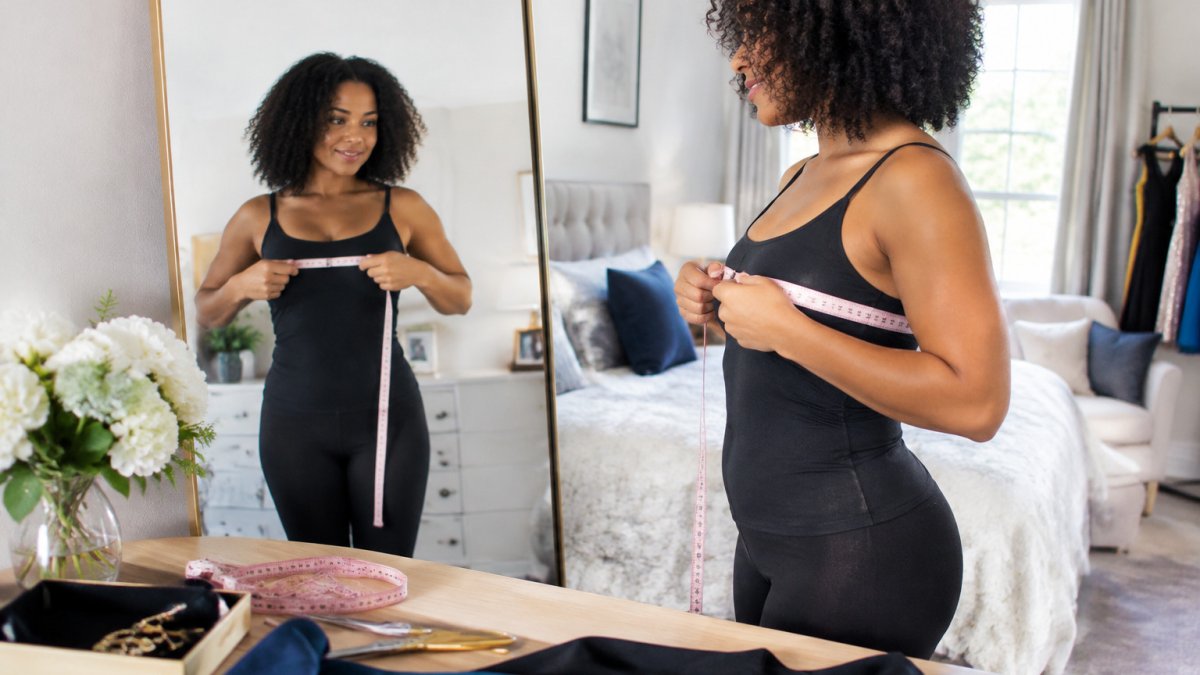
Step 1: Measure the bust. Wrap the tape around the fullest part of your bust, keeping it level across your back.
Step 2: Measure the natural waist. Find your natural waist by bending gently to one side.
Step 3: Measure the hips. Stand with your feet together and wrap the tape around the fullest part of your hips and seat, usually about 7 to 9 inches below your natural waist. Keep the tape level from front to back.
A common mistake is measuring the waist too low. Bending to find the crease keeps you from guessing.
Write down all three numbers right away. Your memory will not be as reliable as a written note.
The three core measurements and how to take each one:
| Measurement | Where to measure | Key tip |
|---|---|---|
| Bust | Fullest part of the bust | Keep the tape level across the back |
| Natural waist | Crease formed by bending gently to one side | Bending finds it, so you do not guess |
| Hips | Fullest part of hips and seat, about 7 to 9 inches below the natural waist | Keep the tape level from front to back |
How to Measure Hollow to Floor Length for a Formal Gown
For a long gown, length matters as much as width. The hollow-to-floor measurement tells a seamstress or a size chart how long the skirt needs to be.
To measure it:
- Put on your heels or the shoes you plan to wear with the gown. Heel height changes the result.
- Find the hollow at the base of your throat, just above the collarbones.
- Hold the tape at that hollow and let it drop straight down past your body.
- Keep the tape against your body, not pulled away from it, and stop at the floor.
- Record the number in inches.
Shoes make a big difference.
If you cannot measure yourself reliably, ask a friend to hold the tape at the hollow while you stand still. Two people make this measurement more accurate than one.
Measuring for Different Gown Silhouettes and Construction
Not every formal gown fits the same way, and the silhouette tells you which numbers deserve a second measurement.
Here is how common styles change the measuring focus, and what to do differently for each:
- A-line and ball gowns: Bust, natural waist, and hip numbers still matter, but the skirt has room to flow over the hips, so small hip variance is usually forgiving. Spend your extra effort on the natural waist and the hollow-to-floor length, since a ball gown's hem is the most visible fit cue.
- Mermaid and fit-and-flare gowns: Measure the hips and the fullest part of the seat closely, and add a high-hip or upper-thigh reading if the product description mentions a fitted skirt through the knee. These gowns have little seam allowance to let out at the hip, so an undersized hip reading can make a simple alteration difficult.
- Sheath gowns: Focus on bust, waist, and hips, and measure the waist twice. A sheath has no gathering or pleating to hide a gap at the waist, so a waist reading that is even half an inch off shows as pulling or bunching in photos.
- Corset-back or lace-up gowns: Measure the upper back width and your natural waist, because the lacing adds structure and adjusts the fit at the back. A corset back can adjust the fit at the waist, so sizing to your bust and letting the lacing handle the waist is a common approach.
- Strapless gowns: Add an upper-bust or over-the-bust reading, taken around the body just above the fullest part of the bust, because the bodice has to hold itself up without straps. A strapless bodice that is too loose at the upper bust will slide down no matter how well the waist fits.
Construction matters as much as silhouette. Boning, lining, and built-in cups change how a gown fits, so a gown with a structured bodice may fit differently than a soft jersey one of the same labeled size.
Watch out: measuring only your bust, waist, and hips for a strapless or corset-back gown leaves out the two readings that decide whether the bodice stays up, so add the upper-bust and upper-back numbers before you order.
Dress Size Chart vs Body Measurements: Which Do You Trust?
Here is the honest answer: trust your body measurements, then use the size chart as a guide. Size charts vary by brand.
Compare your numbers against the chart's body measurements, not the size label.
When your measurements fall across two or three sizes, use this decision process instead of guessing:
- Identify the controlling measurement for the silhouette. For a fitted gown, the hip is usually the controlling measurement because it has the least seam allowance to let out. For a strapless or corset-back gown, the upper bust and bust are controlling. For an A-line or ball gown, the natural waist and hollow-to-floor length are controlling.
- Size to the controlling measurement, not to the average of your numbers. If your bust points to a 10 and your hips point to a 12 in a fitted gown, order the 12 and plan to take in the bust, because letting out a hip is far harder than taking in a bodice.
- Check the fabric's ease. Structured fabrics such as satin, mikado, and duchess satin have little give, so size up when you are between sizes. Stretch fabrics and crepe have more give, so you can sometimes stay with the smaller size if the controlling measurement matches.
- Ask whether the gown can be altered. A gown with a corset back, a generous seam allowance, or a separate bodice and skirt is easier to alter than a fully lined sheath with narrow seams. If the listing does not say, ask before you order.
- Confirm the return and exchange window. If you are ordering online and the size is a close call, check the return policy before you commit, because a gown that cannot be exchanged turns a sizing guess into a costly mistake.
Ordering to your controlling measurement and planning a take-in is one way to approach a close sizing decision.
Watch out: averaging two sizes to split the difference can produce a gown that is too small at the controlling measurement and too large everywhere else.
Tips for Taking Accurate Clothing Measurements and Fixing Errors
Small errors add up fast. Use these tips to get numbers you can trust.
- Measure twice. If the two numbers differ by more than half an inch, measure a third time.
- Keep the tape level all the way around. Check the mirror for a sloped line.
- Do not measure over a jacket or thick sweater.
- Stand in the same spot and posture each time.
- Write down the date with each set of numbers.
If a number seems wrong, check the common causes first. A tape pulled too tight shrinks the reading. A tape that sags in the back inflates it.
Keep a written record of your measurements. Compare them each time you shop, and note which brands fit you best.
Booking Your Shea Marne Fitting and Choosing Your Size
Once you have your numbers, you are ready to choose a size with confidence. At Shea Marne Luxury Collection, we know that a formal gown should fit like it was made for you, especially for a wedding or milestone event.
Start by comparing your measurements with our size guide. You can book personal styling sessions at Shea Marne Luxury Collection for a curated fitting that confirms the right size and silhouette. A reader who wants a hands-on fit can also contact Shea Marne to schedule an appointment and ask questions about alterations.
If you prefer to be measured in person, our African clothing boutique in Maryland is the place to visit for a fitting. And if you are ordering a gown online, check our shipping policy for delivery times and shipping costs before you commit to a size.
Frequently Asked Questions
How do you measure yourself for a formal dress?
Use a soft measuring tape and stand naturally with good posture. Measure the fullest part of the bust, the natural waist at its narrowest point, and the fullest part of the hips, keeping the tape level and comfortably snug without pulling it tight. Measure over light undergarments you would wear with the gown, and record each number in inches. Repeat each measurement once to confirm it, and compare the results against the brand's size chart rather than your usual store size.
Should I wear undergarments when taking dress measurements?
Yes. Measure over the bra, shapewear or underwear you plan to wear under your formal dress, because these change your bust and waist circumference. Taking measurements over bulky or unexpected layers can throw off your numbers by an inch or more. If you plan to wear heels, take your hollow-to-floor measurement while wearing them so the gown length is accurate for the finished look.
How do I measure my hollow-to-floor length for a formal gown?
Stand barefoot or in the heels you plan to wear, and have a helper hold the end of the tape at the hollow at the base of your throat, just above the collarbone. Run the tape straight down over the bust and abdomen to the floor, keeping it vertical and not dipping at the bust. Record the number in inches. Gowns are often cut to this measurement, so an accurate hollow-to-floor length prevents a dress that pools or stops short.
What if my measurements fall between two sizes on the size chart?
When your bust, waist and hips fall into different sizes, you can choose the size that matches your most fit-critical measurement and plan alterations at the waist or hips. If you are between sizes, read the fabric and construction notes, since stretch fabrics and structured bodices fit differently. Contacting the boutique for guidance before ordering can save time and reduce the chance of a return.