 listicle
Luxury Fashion With a Philanthropic Mission: What to Know
Last Updated: November 11, 2026
Quick Summary
A philanthropic mission is a commitment by a business to direct part of its profits, sales or attention toward social causes. In luxury fashion, shoppers judge it by the specifics: the giving model, the rate, the named nonprofit partner and whether results are reported.
- Four main giving models exist: percentage-of-sales, net-profit or fixed-amount, customer-directed, and in-kind support.
- A 5% commitment on a $400 purchase directs about $20 to the cause, before any cap or exclusions.
- Check whether a named partner appears in public nonprofit records such as the IRS Tax Exempt Organization Search.
- Look for reported totals and a defined period, not just mission language or adjectives about giving back.
- Philanthropic commitments do not lower the price of a garment, so judge the giving separately from the purchase.
Table of Contents
- How Fashion and Philanthropy Intersect in Luxury Retail
- Philanthropic Fashion Brands: How Giving Models Differ
- Luxury Fashion Brands That Give Back: Causes They Support
- Ethical Luxury Fashion Brands: How to Evaluate Philanthropic Claims
- Step 1: Pin Down the Specific Commitment
- Step 2: Verify the Nonprofit Partner
- Step 3: Check Whether the Money Is Reported
- Step 4: Separate Demonstrated Results from Mission Language
- Step 5: Watch for Cause-Washing
- Step 6: Distinguish Charitable Giving from Responsible Business
- A Quick Checklist You Can Use in the Store
- Black-Owned Luxury Fashion Brands and Cultural Pride
- Trade-Offs and Concerns Worth Weighing Before You Buy
- Shopping Purpose-Driven Luxury for Your Next Event
- Frequently Asked Questions
How Fashion and Philanthropy Intersect in Luxury Retail
Shoppers who want their money to do more are asking a sharper question than they used to: does the brand behind this dress actually give back?
Here is the tension worth understanding.
Fashion-led giving usually takes one of a few forms: a share of each sale, a limited collection with proceeds set aside, or in-kind support such as community drives.
Philanthropic Fashion Brands: How Giving Models Differ
Not every "giving" brand gives the same way, and the differences matter when you are comparing options. The useful question is not whether a brand gives, but which model it uses, because the model determines how much reaches a cause, when it arrives, and whether you can check it. Four models account for most luxury fashion philanthropy, and each has a distinct trade-off.
Percentage-of-Sales Donations
A percentage-of-sales model ties giving directly to revenue: the brand commits a stated share of each sale, or of sales in a defined window, to a named partner.
Run the math before you are impressed. A 5% commitment on a $400 purchase directs about $20 to the cause, before any cap or exclusions.
Watch out: some percentage claims apply only to a single collection or a promotional window, not to every order, so confirm what the percentage is calculated on before you treat it as an ongoing commitment.
Net-Profit and Fixed-Amount Donations
A net-profit model commits a share of profit rather than revenue, which sounds larger but is harder to verify because profit depends on costs the buyer cannot see. A fixed-amount model commits a set dollar figure, for example, a stated donation tied to a campaign or an annual pledge, which is easier to confirm but does not grow with sales.
Customer-Directed Giving
Customer-directed giving lets the shopper choose among two or three named causes at checkout, and the brand routes the donation accordingly. This model gives you direct influence over where the money goes, which many shoppers value, but it usually comes with a smaller per-order amount and a narrower list of approved partners. Check whether the causes are pre-vetted nonprofit organizations and whether the brand publishes how much each option received.
In-Kind Support and Product Donations
Some brands give products, time, or event support rather than cash, community drives, donated inventory, or staff volunteer hours. In-kind giving can be genuine and locally useful, but it is harder to value and harder to compare against a cash commitment. Treat it as a different category, not a substitute for a stated donation rate.
What Each Model Means for the Amount Reaching a Cause
The practical takeaway is that the model, the rate, and the reporting period together tell you more than any mission statement. A brand that names its model, its rate, its partner, and its reporting period has given you a claim you can evaluate. A brand that describes its giving only in adjectives has not.
The four main giving models differ in how much reaches a cause, when it arrives, and whether a buyer can check it.
| Model | How it works | Key trade-off |
|---|---|---|
| Percentage-of-sales | Stated share of each sale to a partner | Only as large as the sales it comes from |
| Net-profit or fixed-amount | Share of profit or a set dollar pledge | Profit is hard to verify; fixed pledges don't grow |
| Customer-directed | Shopper picks from named causes at checkout | Smaller per-order amounts, narrower partner list |
| In-kind support | Products, time or event support | Hard to value against a cash commitment |
Luxury Fashion Brands That Give Back: Causes They Support
Luxury brands tend to back causes that fit their customers and their identity. Common areas include women's empowerment, girls' education, community support, arts and cultural preservation, and climate or environmental work. Some brands focus on one cause in depth.
Neither approach is automatically better. A focused brand can show deeper impact in one area, while a broad brand may reach more communities.
At Shea Marne Luxury Collection, our giving is built around social enterprise and community impact. Find out more about the Stuff the Bus School Supply Drive for Prince George's County students. You can read the details of the Toy Drive Maryland effort, including how it supported families and community impact. You can read more about how these efforts work in our shopper's guide to supporting Black-owned fashion brands, and you can see the full set of brands we spotlight in our curated list of Black-owned luxury jewelry brands.
Ethical Luxury Fashion Brands: How to Evaluate Philanthropic Claims
A philanthropic claim is only as useful as the evidence behind it. Most shoppers stop at the brand's own marketing page, which is exactly where verification should begin rather than end. Use the checklist below as a sequence: confirm the commitment, confirm the partner, confirm the money moved, and confirm the results.
Step 1: Pin Down the Specific Commitment
Look for a percentage, a dollar amount, or a defined program with a start and end date. General language such as "giving back" or "community-first" is not a commitment you can check. If the brand publishes an impact or giving page, note the model it uses, percentage of sales, net profit, fixed pledge, customer-directed, or in-kind, and the period the commitment covers.
Step 2: Verify the Nonprofit Partner
A named partner is the single strongest signal, because it gives you a second source. Many U.S. nonprofit organizations that are eligible to receive tax-deductible donations appear in the IRS Tax Exempt Organization Search, and many file an annual Form 990 that lists revenue, expenses, and program spending. If the brand names a partner, look the partner up, confirm it is a recognized tax-exempt organization, and read its most recent filing to see whether the described program appears in the organization's own reporting.
Step 3: Check Whether the Money Is Reported
Look for totals, not adjectives: how much was raised, over what period, and to whom it was distributed. A brand that reports a number, even a modest one, is easier to trust than one that reports only photos. Compare the reported total against the stated rate and the brand's visible sales volume; a large gap in either direction is worth a question.
Step 4: Separate Demonstrated Results from Mission Language
Mission statements describe intent. Impact reporting describes outcomes. Look for reporting periods, named programs, and metrics the partner organization also acknowledges. A brand that says it "supports girls' education" is making a mission claim; a brand that says it funded a specific program at a named organization during a stated year is making an impact claim. The second is what you are looking for.
Step 5: Watch for Cause-Washing
Cause-washing is the practice of using a charitable association to signal virtue without a commitment that would survive scrutiny. Common patterns include a one-time campaign presented as an ongoing program, a donation tied to a purchase threshold that few customers reach, and a partnership announced but never reported. None of these is automatically dishonest, but each deserves a direct question before you treat the purchase as a charitable act.
Step 6: Distinguish Charitable Giving from Responsible Business
Charitable giving is one part of a broader picture. Labor practices, material sourcing, and environmental claims are separate questions with separate evidence, and a strong donation program does not answer them. Evaluate each on its own terms rather than letting a visible cause stand in for the rest.
A Quick Checklist You Can Use in the Store
- Is there a stated rate, amount, or defined program?
- Is the nonprofit partner named, and does it appear in public nonprofit records?
- Does the brand report totals or outcomes, with a period attached?
- Is the commitment ongoing, or tied to a single campaign?
- Does the brand distinguish charitable giving from its other responsible-business claims?
A brand that answers these questions openly is easier to trust than one that relies on mood and imagery. If you can't find the specifics, that is useful information too.
For transparency, we will be direct about what we can and cannot promise. You can also see real customers wearing our pieces in our customer gallery, which shows how our products are actually worn at events and celebrations.
Black-Owned Luxury Fashion Brands and Cultural Pride
For many shoppers, the mission and the identity are connected.
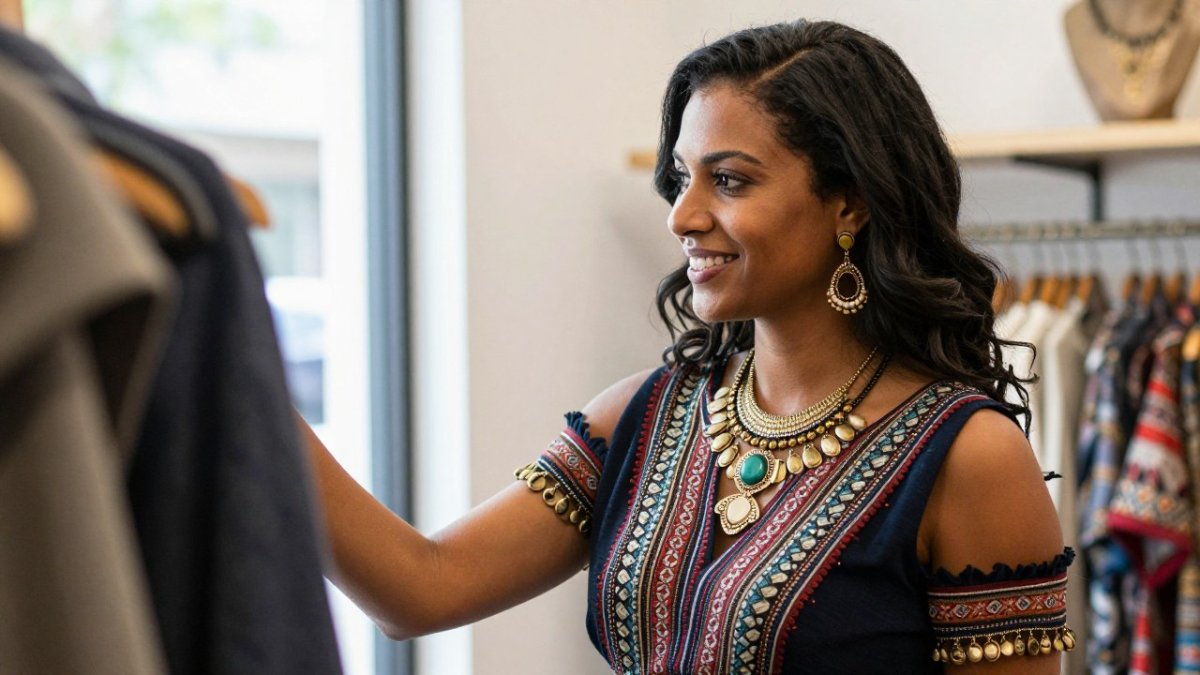
This connection is valuable, but it is not a substitute for proof. A brand's cultural message should be backed by the same standards as any other claim: clear commitments, named partners and honest reporting.
Our own approach reflects that belief. We design couture clothing and handcrafted statement jewelry for women who want to express heritage through modern, elegant pieces, and we pair that with community work we can describe in detail.
Trade-Offs and Concerns Worth Weighing Before You Buy
Purpose-driven shopping involves real trade-offs, and it helps to name them.
- Price. Philanthropic commitments do not lower the price of a garment. Pricing depends on the piece, the collection and the sizing. Check the brand's website for current prices.
- Donation size. A percentage can sound generous, but the actual dollar amount depends on how much you spend and how much the brand sells overall.
- Shifting causes. Brands sometimes change partners or campaigns. Ask whether the commitment is stable.
- Marketing overlap. A cause can be used to sell products. Separate the mission from the sales pitch when you judge the claim.
Weigh these honestly. A purchase can be meaningful and still not be the most cost-effective way to give. If the cause is what matters most to you, a direct donation may do more for that cause.
Shopping Purpose-Driven Luxury for Your Next Event
If you are shopping for a wedding, a milestone celebration or a business event, start with fit and purpose.
Pair a statement necklace or earrings with a simple dress to keep the look balanced.
Whatever you choose, buy for the moment you are celebrating and the cause you want to support.
Shop Shea Marne Luxury Collection today and find couture and statement jewelry designed to celebrate your heritage and your purpose.
Frequently Asked Questions
What are some philanthropic fashion brands?
Philanthropic fashion brands are labels that direct part of their sales, profits or fundraising campaigns to nonprofit organizations or causes such as women's empowerment, girls' education, climate action or arts preservation. Examples commonly cited include brands running cause-linked capsule collections and percentage-of-sales programs. Because brands change their programs often, check each company's current site for the specific organizations it supports, how much it gives, and whether it publishes impact reports before assuming a label is still accurate.
How can I tell whether a fashion brand's philanthropic claims are credible?
Look for specifics: the named nonprofit, the donation percentage or dollar amount, the time period covered, and any cap on total giving. Credible brands publish how funds are sent and provide impact reporting or receipts from partner organizations. Be cautious of vague phrases like 'a portion of proceeds' with no figure, or cause marketing that is not matched by any published allocation. Checking whether the partner nonprofit confirms the partnership also helps.
Do luxury fashion brands donate a portion of their sales to nonprofits?
Some do, but models vary widely. Some donate a fixed percentage of each sale, others donate a set amount from a limited collection, and others run fundraising campaigns or match customer donations. The percentage and the cap matter as much as the headline, since a brand may promote a cause while giving a small share of revenue. Read the terms of each program before you buy.
How can I support Black-owned fashion brands with a social mission?
Start by shopping directly with brands that state their ownership and mission clearly, then check how they use their platform: whether they support community programs, cultural preservation or education, and whether they publish how those efforts are funded. Sharing reviews, buying from the full collection rather than only discounted pieces, and returning to the brand for future purchases also sustain the business beyond a single campaign.